Care Content Procurement
Jewelry Care Card Specifications for Private Label Brands: A Buyer’s Checklist
A small care card can carry a large assumption: that one cleaning instruction suits every piece inside the box. A private-label collection may combine different stones, plated surfaces, settings and detachable components, so copying a familiar card can give the customer an instruction that was never reviewed for the actual product. This guide helps founders, buyers and product developers build the content record before approving the print file. It connects each statement to the supplied SKU and its confirmed construction, separates consumer wording from technical evidence, and follows the language and artwork versions through pack-out and repeat orders. The result is a reviewable care-information brief, with open questions assigned before printing rather than filled with unverified performance promises.
TL;DRThe short answer
Identify the products and markets covered. Support each care statement with relevant product information and supplier confirmation, then approve consumer wording, translations and an actual print proof. Link card revision to the product and packaging matrix, and control obsolete stock when either the instructions or construction changes.
Direct answer
What should jewelry care card specifications include?
Define the reader, destination market and exact SKU or product family covered. Link the confirmed materials, finish, stones and assembly to the source and owner of each care statement. Approve consumer wording, exclusions, language versions, artwork and an actual print proof. Record the card-to-product packing matrix, correction process and reorder revision, while keeping legal review and performance validation separate from ordinary content approval.
Decision summary
Key takeaways
- A material name alone does not approve a cleaning method.
- One card needs an explicit product scope.
- The printer receives approved wording; it does not establish product requirements.
- Translate restrictions as carefully as the positive instruction.
- Control old cards when products or wording change.
Define the reader, product range and destination before writing
Start with the customer action the card must support and the products it accompanies. Identify the exact SKU revision, intended sales market and languages, then state whether the card covers one piece, a coordinated set or a defined product family. A family name should not hide different stone treatments, surface finishes or assembly methods. Name the differences first and ask whether a shared instruction remains suitable for every included version before choosing a single artwork file for the range.
Separate ordinary handling information from warnings or disclosures that may require another responsible reviewer. The destination market and actual product determine that review; this checklist supplies no legal conclusion. Pryntco’s printing guidance places responsibility for required wording with the business supplying the product. Assign a named content owner on the brand side and a supplier contact for construction questions. The printer should receive the approved result and its version, rather than being asked to infer requirements from a photograph or a short product title.
Evidence: Pryntco
Build a statement-to-product evidence table
Collect the current material schedule, finish description, stone information and relevant assembly details. Distinguish confirmed facts from proposed options and unresolved information. For each draft statement, record the source, its date or revision, which product configuration it covers and who confirmed that it can be used. A supplier email should identify the actual construction, rather than simply saying that the brand’s usual card is acceptable. Keep any supporting technical document linked to the row instead of replacing it with a short marketing phrase.
Care can depend on more than the main metal. Stones, treatments, coatings, stringing, adhesives or detachable elements may need different handling considerations if present in the confirmed construction. GIA explains that some gemstone treatments affect care. That supports asking for the treatment and assembly information; it does not identify a treatment on an untested catalog item. Use the natural gemstone guide and the material pages to organize the enquiry, then request product-specific confirmation for the proposed consumer instruction.
Evidence: GIA
Resolve mixed-material and product-version boundaries
Review the complete supplied piece before combining instructions from separate materials. A statement suitable for a plain metal component may not suit the stone, finish or connection attached to it. Identify the exact question to resolve with the relevant supplier: cleaning contact, storage, surface abrasion or another intended action. Do not select the most permissive instruction in the file and assume it covers the assembly. Where a shared statement cannot be supported, split the card families or provide a clearly scoped product-specific instruction.
Published brand guides demonstrate why scope matters. Agatha describes care for its own plated and silver-tone jewelry, while Louis Vuitton’s jewelry guide points readers to stone-specific product recommendations. These are examples of manufacturer-owned communication, not transferable approval for Zalson products. Keep another brand’s warranty, cleaning technique and service policy outside your card. If a plated version replaces a previous finish or a new stone option is added, reopen the affected evidence rows even when the visible collection name remains unchanged.

Evidence: Agatha Paris; Louis Vuitton
Approve useful consumer wording without adding performance claims
Write the customer instruction as a clear action with the necessary condition or restriction nearby. State what the approved information actually supports. A consumer does not need internal production jargon, but removing jargon must not remove a material limitation or change the meaning. Keep cleaning, contact, storage and packaging advice in separate rows during review so each can be traced. This article does not supply a cleaning formula: the content owner must resolve the instruction for the actual product before it is printed.
Do not turn a precaution into a promise. Advice about avoiding a substance does not establish resistance to that substance, and a storage recommendation does not establish a lifetime. GIA’s pearl guide specifically excludes ultrasonic and steam cleaning for pearls, illustrating that a generic jewelry-cleaning message can miss a material boundary. Use that example to check the relevance of a proposed instruction, not to certify every pearl-like object or invent a care trial. Keep unsupported waterproof, allergy, corrosion and durability claims out of the approved artwork.
Evidence: GIA
Control translations, restrictions and accessible reading
Approve a source-language version before translating and assign an identifier to each language file. Check product terms, affirmative actions, restrictions and exceptions line by line. A translation that omits a negative or changes an occasional instruction into a daily routine changes the instruction itself. Give the reviewer the applicable product context and the approved source, not only a screenshot of the finished card. Retain the review decision and resolve uncertain terms before the artwork is released to the printer.
Test readability using an actual-size proof in the intended language. Review text contrast, line breaks, heading order and whether the necessary conditions remain close to the action. A translated paragraph may need more room than the original. Change the layout rather than silently deleting a restriction to fit a box. If an online care page supplements the card, verify its public address, language and product scope; the physical insert should still communicate its intended purpose and provide a usable route to assistance.
Use a blank care-content and artwork worksheet
Attach the content worksheet to the product and packaging records before sending a print order. One row should identify the applicable piece or family and another the instruction evidence. The table is deliberately blank where a supplier or responsible reviewer must provide an answer. A sample card from a competitor or printer can illustrate format, but it does not fill those fields. When a source is inaccessible or lacks the relevant configuration, retain that limitation and obtain confirmation rather than inventing a missing instruction.
Keep content approval, linguistic review and artwork approval as distinct recorded decisions. A correctly spelled sentence may still be unsuitable for the product, while a supported instruction may become unreadable after layout. The sample approval checklist supplies the wider release framework. Link its status to the exact care document and actual print proof so a later approver can identify what was checked. Record open decisions with an owner and release condition; do not count a printer’s receipt of the file as evidence of product-specific approval.
| Field | Buyer definition | Evidence / approval record |
|---|---|---|
| Applicability | SKU / family / revision ___ | Included and excluded versions ___ |
| Reader and market | Audience ___ / destinations ___ | Languages ___ / responsible reviewer ___ |
| Construction | Materials / finish / stones / assembly ___ | Source files ___ / supplier confirmation ___ |
| Care statement | Action / condition / restriction ___ | Evidence ___ / scope ___ / owner ___ |
| Language | Source text ___ / translation revision ___ | Meaning and readability review ___ |
| Artwork | Layout / card dimensions ___ | Actual print proof ___ / approval date ___ |
| Pack-out | Product-to-card matrix ___ | Old stock / correction / reorder rule ___ |
Review the physical print proof with the actual packaging
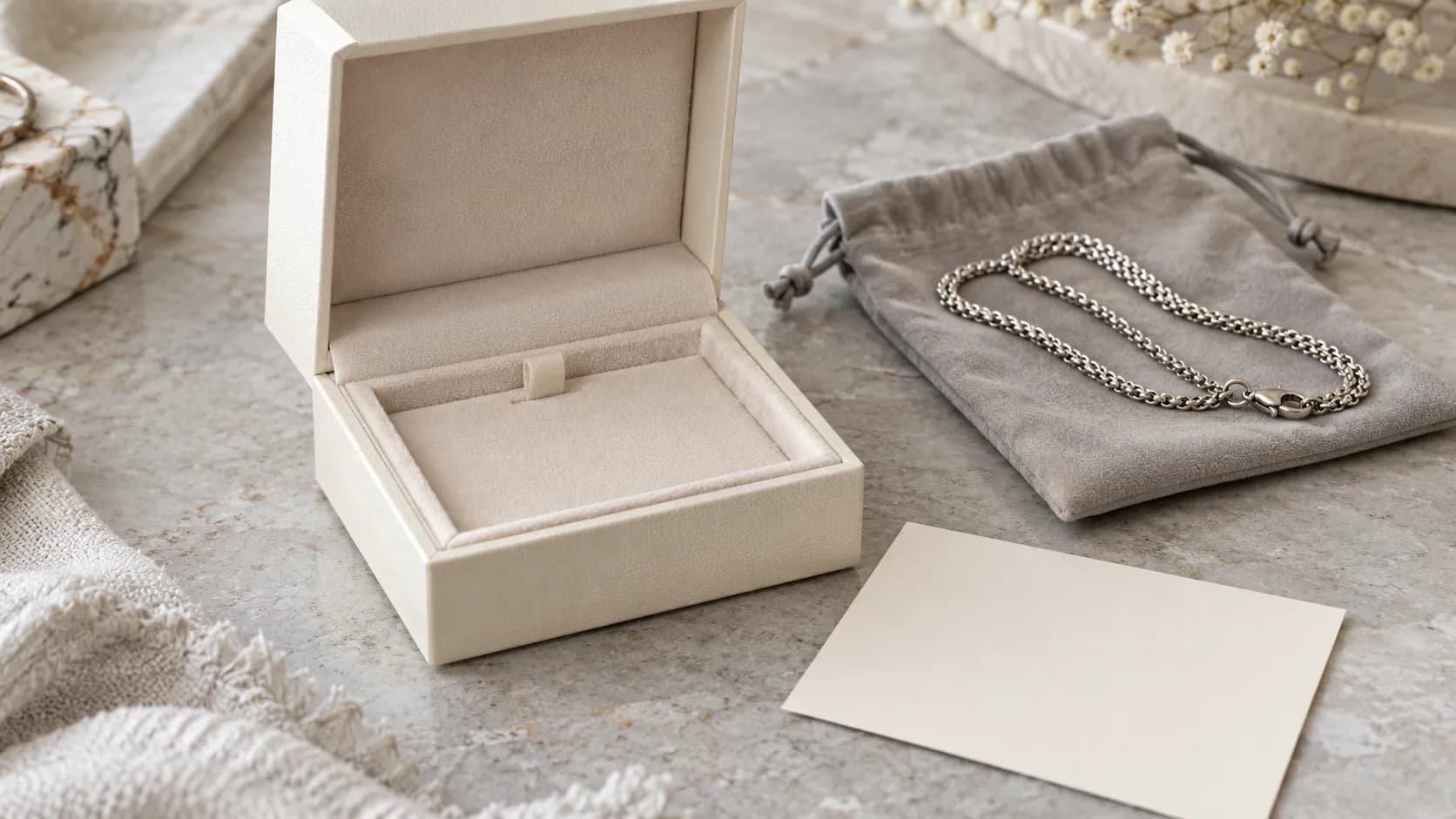
Put the proposed printed card into the intended box or pouch beside the approved product configuration. Check that it can be read and removed and that folding or securing it does not obscure the critical instruction. Review the physical printed side, orientation and final text against the released file. This step checks content delivery and packing fit; it is not a test that the stated care method works or that a surface will resist a particular exposure.
Identify the proof and retain a copy with the approved artwork. If the printer changes paper, finish, fold or dimensions, assess whether the change affects legibility or how the insert sits in the package. The packaging checklist remains responsible for the wider box, insert and transport requirements. OD’s multi-material care guide is useful as an example of organizing information by material, but its broad consumer advice is not an acceptance specification for the printed card or for the jewelry it accompanies.
Evidence: OD’s Jewellers
Correct old cards and release one product-to-card matrix
Use a matrix connecting each product revision and language market to the approved card artwork and print lot. Include the quantities required for complete sets, individual pieces and separately packed replacements. Receiving and packing teams should be able to select the card from that record without deciding by visual similarity. If a product family is split after review, identify the remaining stock assigned to each branch and prevent the earlier general card from continuing to circulate by default.
When an incorrect instruction is found, record the affected wording, products, card versions and known stock locations. Assign the responsible person to decide containment, corrected material and any customer communication required by the actual circumstances. Keep the old version as history while removing it from the active print and pack-out selection. A design change or a repeat order should trigger a check of care applicability as well as artwork availability. Send the product evidence and unresolved care questions through request a quote before authorizing the next printing quantity.
- Identify included and excluded product versions.
- Confirm care evidence and responsible content owner.
- Separate instructions from unsupported claims.
- Check translations, negatives and readable layout.
- Approve the actual print proof in its package.
- Control corrections, old stock and reorders.
1. Scope
Identify products, reader and markets.
2. Support
Link each instruction to applicable evidence.
3. Write
Approve clear consumer wording and restrictions.
4. Translate
Review meaning and actual-size readability.
5. Proof
Compare printed card, artwork and packaging.
6. Control
Release the matrix and remove obsolete versions.
| Situation | Question to resolve | Controlled outcome |
|---|---|---|
| One plain piece | Which confirmed construction is covered? | One scoped instruction record |
| Multi-material assembly | Do the instructions suit every component? | Confirmed whole-product wording or separate scope |
| Translated insert | Did meaning or restrictions change? | Reviewed source and language versions |
| Changed product or old card stock | Which versions remain applicable? | Stock disposition and updated packing matrix |
Catalog references
Related products
These real catalog products are visual and construction references for specification discussions. Their published product data is unchanged; they are not presented as the exact product used in this guide.

Cushion Sakura Pink Halo Rose Gold 4-Prong Studs
S925 Sterling Silver, Full Thick 18K Rose Gold Plating, Sakura Pink CZ, Round Pave CZ Halo
View product →
Rose Quartz with Hetian Green Nephrite Jade Pendant
Sterling Silver
View product →
Wide Grooved Dome Band Signet Ring
S925 Sterling Silver, Rhodium Plated, High Polish Dome
View product →FAQ
Frequently asked questions
Can one care card cover an entire collection?
Only when its instructions are confirmed as suitable for every included configuration. Record the covered versions and exclusions; split the card family if a shared instruction cannot be supported.
Who should approve the care wording?
The brand’s responsible content owner should approve it with relevant supplier confirmation and any specialist review needed for the product and destination. Printing supplied words does not establish their suitability.
Does a material name establish a safe cleaning method?
No. Review the whole product, including its finish, stones, treatments and relevant assembly details. Obtain instructions applicable to that configuration before approving consumer wording.
Does care card approval prove performance or legal compliance?
No. Content, language and print approval are distinct from product testing and target-market legal assessment. Keep the evidence and responsible decisions separately identified.
When should the card be reviewed again?
Review it when the product construction, supplier information, approved wording, language, layout or applicable requirements change, and before reusing it on a repeat order. Record the treatment of obsolete stock.
Expert review
Zalson Jewelry Product Development & Quality Team
Technical editorial team
Buyer-side specification and reference-control editorial scope. No actual paired-item inspection, care trial, professional translation certification or legal assessment is reported.
Zalson Jewelry is operated by Guangzhou Zalson Jewelry Co., Ltd., established in Guangzhou in 2017. Content is reviewed by the team rather than attributed to an individual spokesperson.
Sources and further reading
- 1GIA: Caring for jewelry — treatments and care boundaries ↗
- 2GIA: Pearl care — material-specific restrictions ↗
- 3Agatha Paris: Manufacturer care guide — scoped consumer communication ↗
- 4Louis Vuitton: Jewelry user guide — English care section, pages 20–22 ↗
- 5OD’s Jewellers: Care and cleaning — material-based organization example ↗
- 6Pryntco: Care instruction cards — content ownership and physical proof ↗
Evidence before print