Size & Placement Procurement
Necklace Length Specifications for Jewelry Brands: A Buyer’s Worksheet
A necklace can match the length printed on an order and still place its pendant differently from the brand’s reference. The chain may have been measured with a different clasp endpoint, an unused extender may have been counted, or the reference may show a different neck and neckline. For independent jewelry brands, buyers and product developers, the useful question is not simply which length looks attractive. It is which finished dimensions, fastening positions and placement observations both parties can reproduce. This worksheet separates those decisions before quotation and sampling. It also connects layering intent to the actual SKU and quantity plan, so a length revision does not quietly leave the pendant, packing insert or delivery forecast on an older version.
TL;DRThe short answer
Write the wearing goal separately from the finished dimensions. Identify the open-length endpoints, clasp contribution and each usable closed fastening position. Define the pendant’s attachment, orientation and drop on a separate row. Review the intended layers and boundary sizes on identified physical references, then attach the method, allowed range and approval version to the SKU quantity matrix.
Direct answer
What belongs in necklace length specifications?
Record the style and SKU, finished-length endpoints, measuring state, clasp contribution and actual usable adjustment positions. Specify pendant attachment, orientation and drop separately from the chain path. Add target-market fit-review references, layer relationships, boundary samples, tools, agreed dimensional ranges and quantities. Release the identified drawing and physical sample together, and reopen dependent checks whenever length or hardware changes.
Decision summary
Key takeaways
- A wearing goal is an observation to review, not a finished chain dimension.
- An open end-to-end reading and the usable closed path can differ.
- Record the loop actually fastened; unused extender is not extra closed length.
- Pendant drop, attachment and direction need their own references.
- Approve boundary variants and the size/SKU quantities before release.
Separate the wearing goal from the finished necklace
Begin with the customer group, market, neckline and visual intention: a pendant visible above a collar, a longer focus below another necklace, or a coordinated set sold together. Record these as review goals. Then define the manufactured article using drawing dimensions and an identified physical sample. A neck circumference describes the reference wearer; it is not automatically the order length. A styled photograph communicates a direction but cannot establish endpoints, slack, hidden extension links or a universally repeatable wearing position.
Kate & Kole’s sizing guide acknowledges that model placement varies between people. Use that limitation constructively: identify the reference necklace, display form or consenting fit reviewer and note the conditions. Do not turn an illustrative collarbone chart into a promise for every customer. This article owns the finished necklace and placement record; the chain and clasp component guide retains the detail on link construction and mating hardware, while the bracelet size worksheet and ring size guide handle their own measurement geometries.
Evidence: Kate & Kole
Draw the open endpoints and account for closure overlap
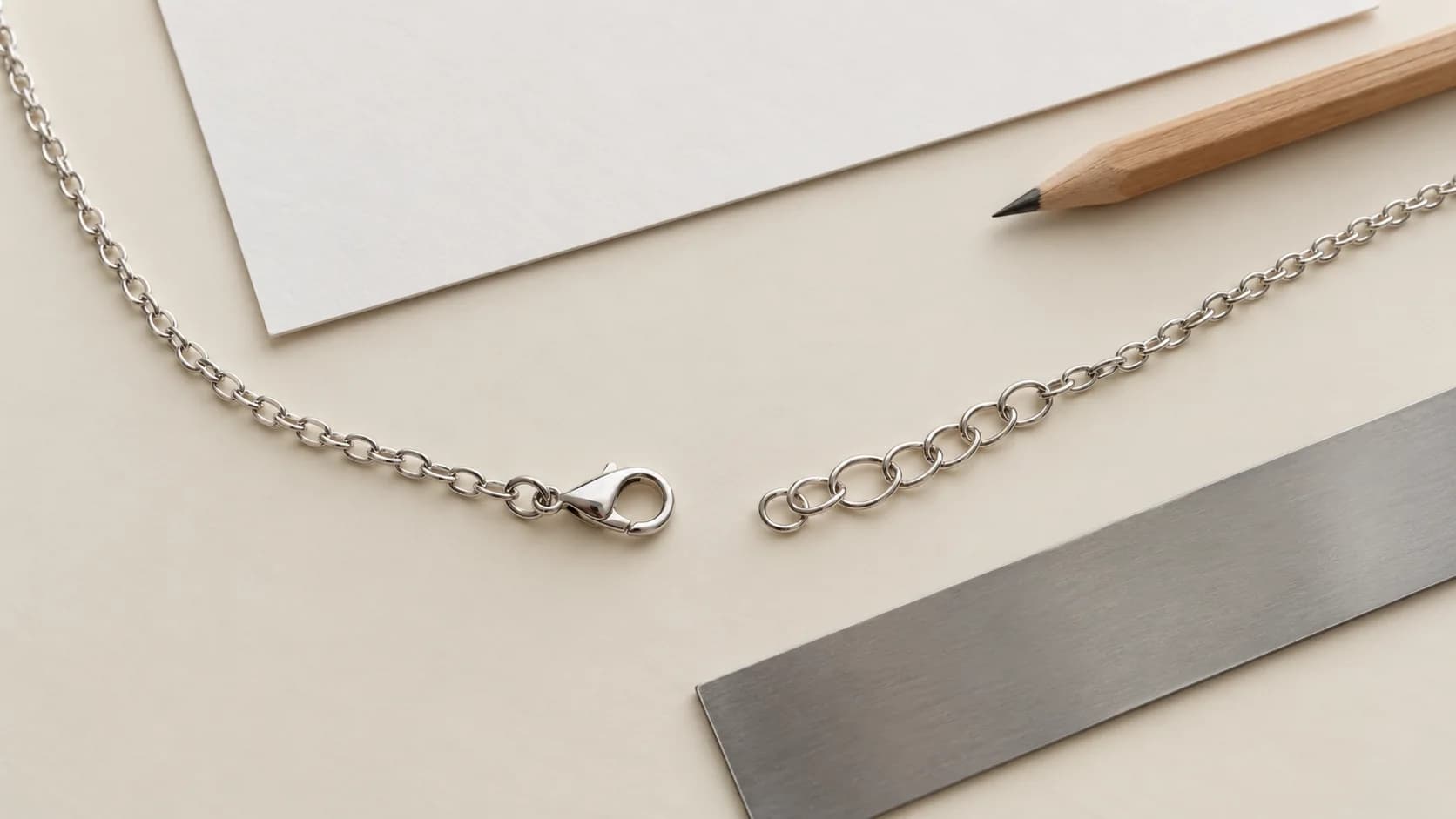
Label endpoint A and endpoint B on a drawing or close photograph of the actual assembly. State whether the dimension follows the chain path or a straight reference, whether the clasp is open, and which end rings and extension parts are included. Separately describe the usable path when the selected fastening point is closed. A box-clasp tongue can overlap inside its receiver; adding every component’s overall dimension may therefore overstate the usable closed length. Ask the supplier to reconcile the drawing with the assembled sample rather than subtracting a guessed allowance.
QxH’s public retailer measurement document distinguishes usable length and closure contribution, including adjustable positions. These are that retailer’s conventions, not a universal Zalson rule. GS1’s accessible Package and Product Measurement Standard is release 3.3, ratified August 2026; its necklace section concerns nominal product-data measurement in an identified natural state. It does not supply a customer fit guarantee or this order’s production tolerance. If a selling platform needs GS1 attributes, maintain them alongside the buyer’s engineering fields and label the different purposes clearly.
List actual usable adjustment positions, not just extender length
Give each intended receiving loop or slider setting a reference. Record the shortest and longest usable states and any intermediate positions offered to customers. Check that the selected clasp can engage the intended loop on the assembled article and that an ornament does not obstruct access. The loose tail beyond the fastened loop belongs in its own appearance and packing review; it should not inflate the closed length at that setting. Do not infer a continuous adjustment range merely because several links are visible in a photo.
For a slider or another continuously adjustable construction, ask the supplier how a position is set, reproduced and checked. Record any proposed operating review separately from a dimensional reading; one successful fastening is not lifetime evidence. If a supplier replaces the clasp or extension link, retain the old record and reopen the affected positions. Include the sample approval checklist with the RFQ so the buyer and supplier know which physical configuration must be available before the size claim is approved.
Specify pendant drop, center and direction independently
Define pendant height and the intended drop from named points: for example, from the chain’s support point to the lowest pendant point in a stated resting orientation. State whether the bail and connecting ring are included. Mark the pendant centerline, attachment locations and front direction on front and side views. For an intentionally off-center pendant, dimension its reference from an identified point rather than asking the factory to ‘center it’ by eye. A movable bail and a fixed two-sided connection need different position records.
Button Daisy’s own guide distinguishes an ornament suspended below the chain from a bar incorporated between its two sides. That distinction helps explain why pendant height cannot simply be added to chain circumference to calculate vertical placement. A two-sided center ornament can contribute to the necklace path; a hanging pendant extends below its support. Ask for the CAD approval views and the physical sample that resolve the chosen construction. The catalog references below are real designs for discussion, without asserting unpublished dimensions or approved lengths for them.
Evidence: Button Daisy
Review layers and target-market references in motion
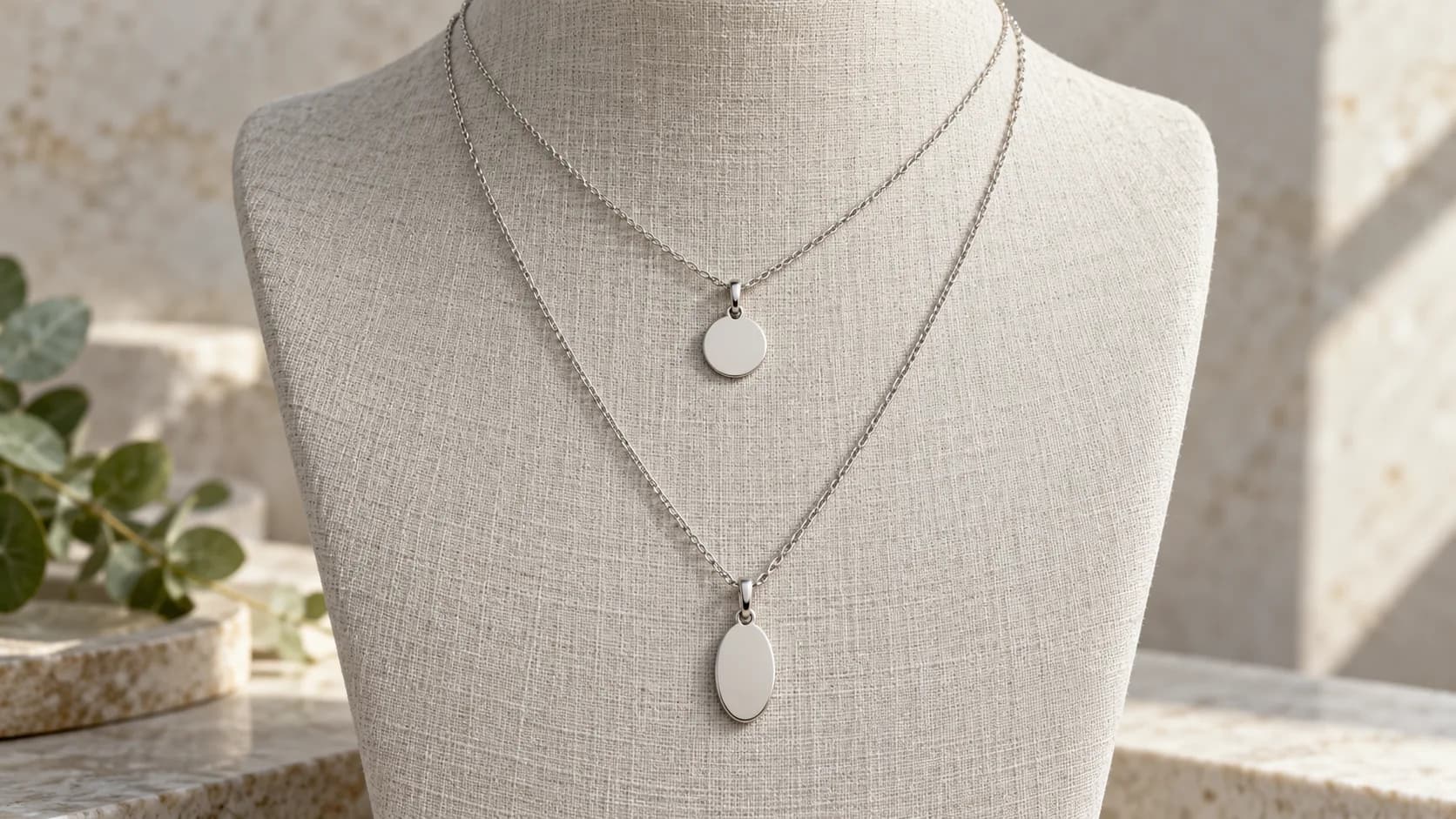
For a layered set, identify each chain, fastening setting and pendant separately, then record their intended order and relative resting positions. Decide whether the layers share a clasp or remain independent. Review the complete proposed set, including how the tails and attachment points behave when the reference moves, turns or changes posture. Record crossing, contact, rotation or loss of the intended spacing as observations to resolve. A neatly arranged display is useful for discussion but cannot prove that layers never tangle during wear.
Choose fit-review references that reflect the brand’s intended neck range and market instead of using one model for every SKU. Record neck-reference measurements only with an agreed method and suitable consent; an identified display form may be enough for an early placement comparison. Review smallest and largest proposed configurations, then any intermediate design that changes construction. Carat Theory’s October 6 guide separates chain path from pendant extension and treats placement as wearer-dependent. Its available retail adjustment lengths are not imported into this buyer worksheet.
Evidence: Carat Theory
Agree tools, conditions, ranges and a recheck route
Write the unit, tool identity, support surface, finished condition and permitted handling alongside each critical dimension. For a flexible chain, agree how it is laid out without stretching and how curved or articulated sections are supported. For pendant drop, state whether the article is lying flat or suspended and what establishes its orientation. Let the supplier propose a feasible range where the buyer has only a target; approve that range and the sample coverage explicitly before manufacturing. Keep fit observations distinct from measured dimensional acceptance.
If receiving and factory readings disagree, identify the same SKU and sample revision, reconcile unit and endpoints, check the tools, and repeat the same setup before deciding disposition. Record each reading, operator, date and condition; do not average incompatible methods into a pass. Escalate unresolved cases through the quality control plan with an owner and a hold or recheck decision. No universal length tolerance, neck allowance or pendant-drop value is supplied here. The accepted range belongs to the actual design and agreed measurement method.
Complete a blank necklace-length and placement worksheet
Attach one controlled worksheet to the quotation brief. Keep unknown values blank or label them supplier-proposed, with an owner and decision date. An illustration cannot complete a missing field. The worksheet should let another reviewer identify what was measured and which placement observation was approved without asking the original designer to reconstruct the discussion from messages. Reference any material and surface-finish documents by version instead of copying inconsistent descriptions into several files.
Before release, reconcile every row with the sample and the order matrix. A buyer may accept the appearance while holding a measurement decision; record that limited status explicitly. Keep the actual sample ID and original observations when a later revision is issued. If the pendant’s visible face also needs a regional polish or texture decision, use the surface finish specification worksheet as a separate linked record. Approval of length alone does not approve material, coating, texture or production quantities.
| Record | Buyer input | Supplier proposal / approved result |
|---|---|---|
| Identity / intention | Style ___ / revision ___ / market ___ / wearing goal ___ | Drawing ___ / sample ___ / reviewer ___ |
| Finished chain | A ___ to B ___ / path ___ / open or closed ___ | Included fittings ___ / overlap ___ / value ___ |
| Adjustment | Position IDs ___ / offered settings ___ | Each usable closed length ___ / tail ___ |
| Pendant | Support point ___ / bottom point ___ / centerline ___ | Drop ___ / bail included? ___ / front direction ___ |
| Layers / fit | Layer order ___ / target references ___ | Resting and movement observations ___ / boundaries ___ |
| Acceptance | Unit ___ / tool ___ / condition ___ | Target and allowed range ___ / coverage ___ / recheck ___ |
| Release | Open issues ___ / decision owner ___ | Version ___ / decision ___ / actual date ___ |
Tie length variants and boundary sizes to SKUs and quantities
Use one order row for each sellable length and relevant material, finish or pendant combination. Separate the marketing size label from the measured finished requirement. An adjustable necklace may be one SKU with several positions, while separate fixed-length versions may need separate rows. Record units as pieces or sets and reconcile the total with the quote. Stuller’s chain guide distinguishes ready lengths from chain sold by length; confirm who supplies cutting, findings and assembly before comparing those offers with a finished-necklace quote.
For the shortest and longest variants, check link count, pendant balance, available adjustment, chain layout on the card and box closure. A repeated link pattern may require the supplier to propose achievable boundary dimensions rather than scaling the whole design. If a requested revision changes a center ornament or chain weight, reopen the dependent sample and pack review. Do not assume the finished-style MOQ applies identically to every length split; ask for an acknowledged matrix through the existing MOQ and variant guide.
| Style / SKU / revision | Finished length and position IDs | Pendant / layers / sample | Quantity and pack unit |
|---|---|---|---|
| Shortest variant ___ | Target ___ / allowed range ___ / method ___ | Drop ___ / reference ___ / boundary sample ___ | Pieces or sets ___ / insert ___ |
| Intermediate variant ___ | Target ___ / allowed range ___ / method ___ | Drop ___ / reference ___ / review status ___ | Pieces or sets ___ / insert ___ |
| Longest variant ___ | Target ___ / allowed range ___ / method ___ | Drop ___ / reference ___ / boundary sample ___ | Pieces or sets ___ / insert ___ |
| Adjustable SKU, if used ___ | Usable positions and values ___ | Selected setting per review ___ | Quantity ___ / total reconciliation ___ |
Evidence: Stuller
Compare the procurement question by necklace construction
A shared label such as ‘pendant necklace’ can hide different dimensional questions. Use the scenarios to determine which records need separate approval. For a hanging pendant, chain path and drop are independent fields. For an integrated ornament, its span affects the assembled path. For adjustable or layered designs, the fastening configuration must be identified as carefully as the nominal length. None of these scenarios establishes a standard size or a guaranteed wearing result.
When requesting OEM necklace size brief feedback, send the complete proposal and ask the supplier to list assumptions that affect price or sampling. A lower quote based on a bare chain is not comparable with a quote including pendant assembly and retail packing. Resolve the variant-specific inputs before sample release, then preserve the response with the drawing revision. The purpose of the comparison is a clear purchase decision, not a preferred chain type for every customer.
| Scenario | Separate records | Physical question to resolve |
|---|---|---|
| Fixed hanging pendant | Finished chain path; bail and pendant drop | Where does the pendant rest on the agreed reference? |
| Integrated center bar | Ornament span within the path; attachment orientation | Does the assembled center remain as intended? |
| Extender necklace | Each usable position; unused tail | Can the proposed clasp engage each offered position? |
| Layered set | Each layer / setting; relative pendant positions | What changes when the complete reference moves? |
Use a six-step release and length-change checklist
Release the drawing, worksheet, matrix and sample as one identified baseline. Record unresolved items as holds rather than leaving the supplier to interpret them as approved. A length change can affect chain-link counts, connector placement, pendant position, packaging contact and the production forecast. Use the design change request to identify affected work and quantities; ask for the quotation and sampling impact before authorizing a revised release.
The packaging checklist and production lead-time guide handle their detailed downstream decisions. Here, confirm that they reference the new necklace version and that old cards or inserts are not silently reused where fit has changed. Send the team a real catalog URL, your target market, the blank fields and the intended quantities through request a quote. These editorial scenes support the discussion; only the project’s actual drawings, samples and agreed checks can close it.
- Identify wearer goal separately from finished dimensions.
- Mark endpoints, closure overlap and each usable adjustment setting.
- Define pendant drop, center, connections and direction.
- Review layers, target references and boundary configurations.
- Approve tools, conditions, allowed ranges and dispute rechecks.
- Reconcile SKU quantities, sample version, packaging and release date.
1. Brief
Name target market, placement goal and selling variants.
2. Define
Draw endpoints, closure state and pendant references.
3. Sample
Build and identify the proposed configurations.
4. Review
Check dimensions, boundary sizes and layer behavior.
5. Release
Approve ranges, SKU quantities and linked records.
6. Control
Assess a length change before replacing the baseline.
Catalog references
Related products
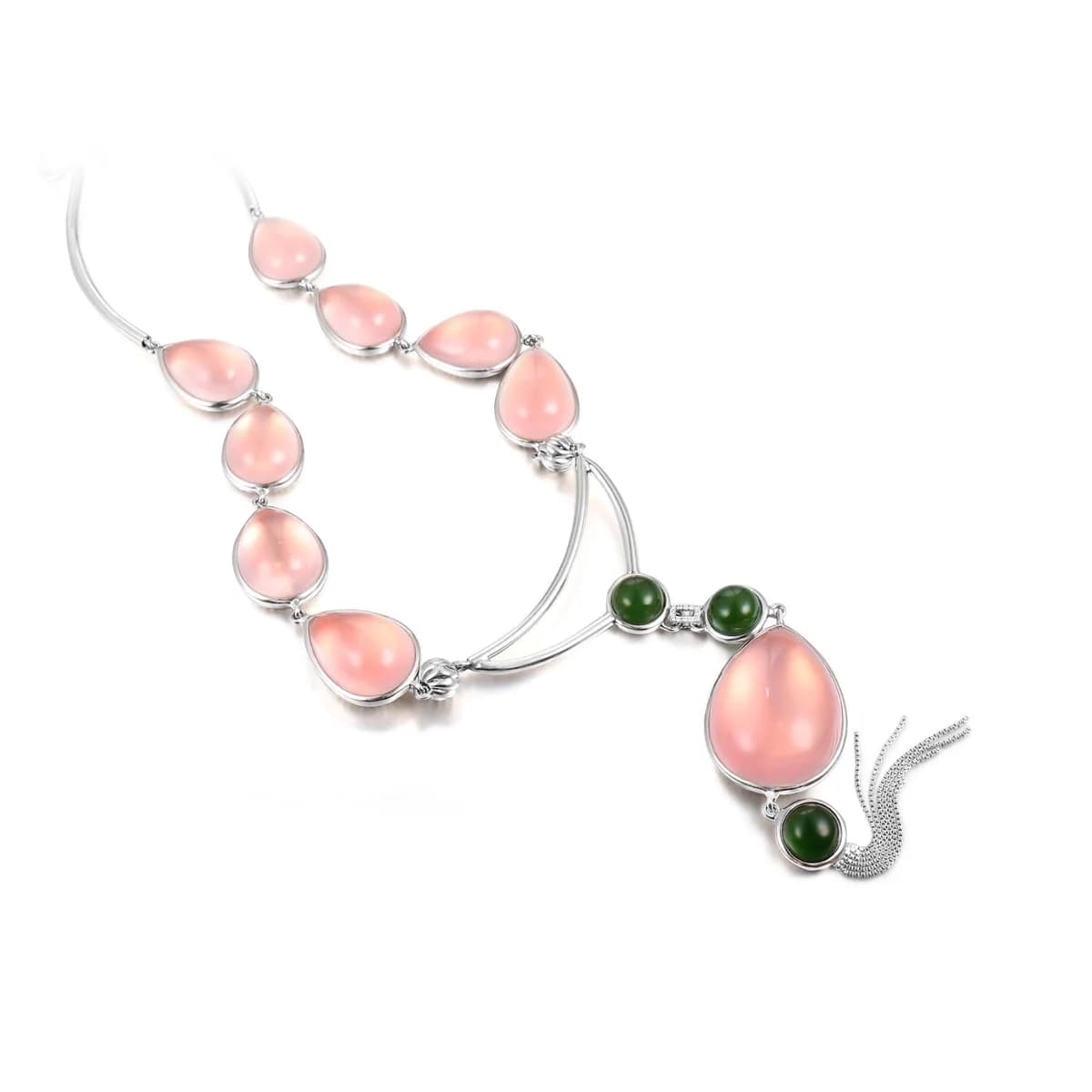
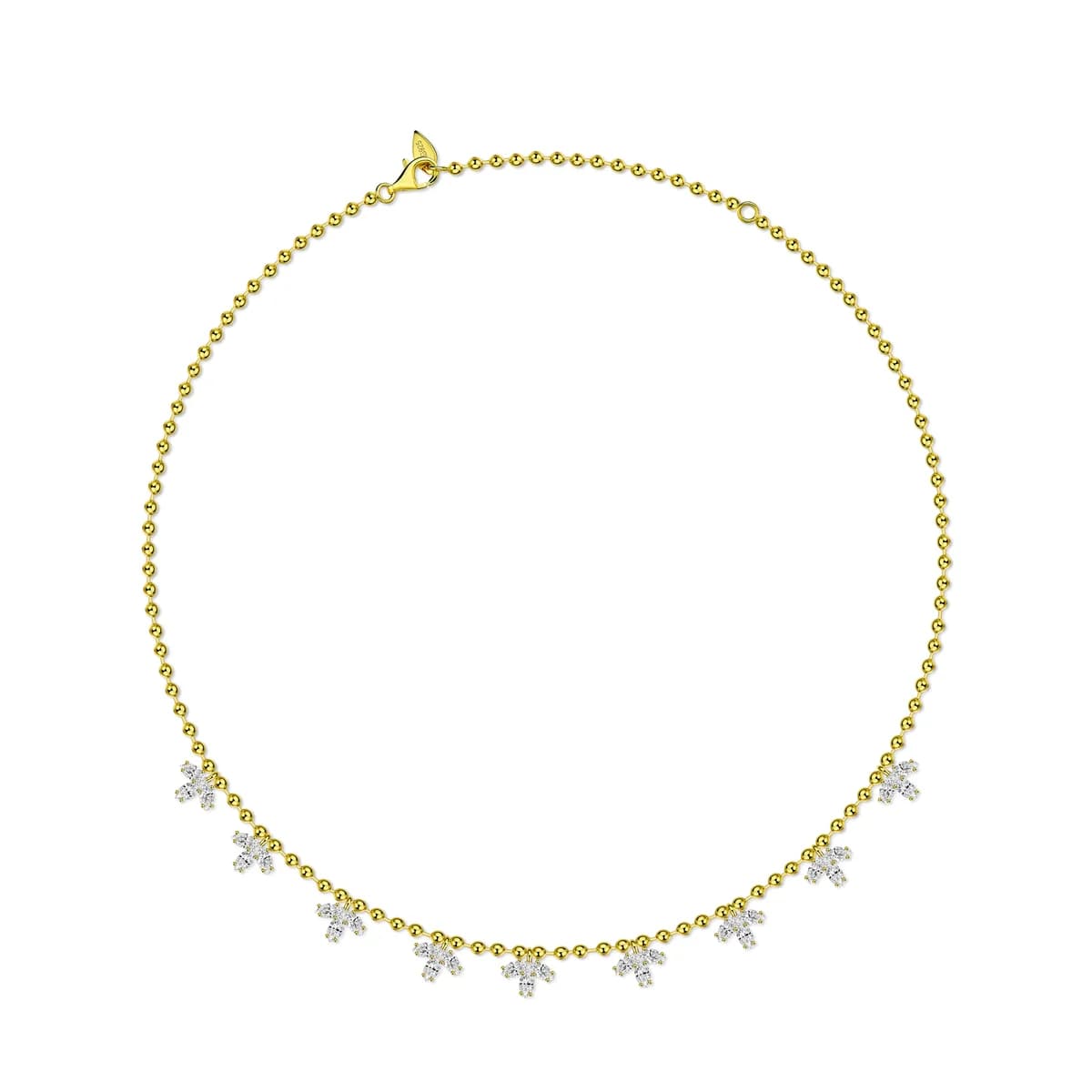
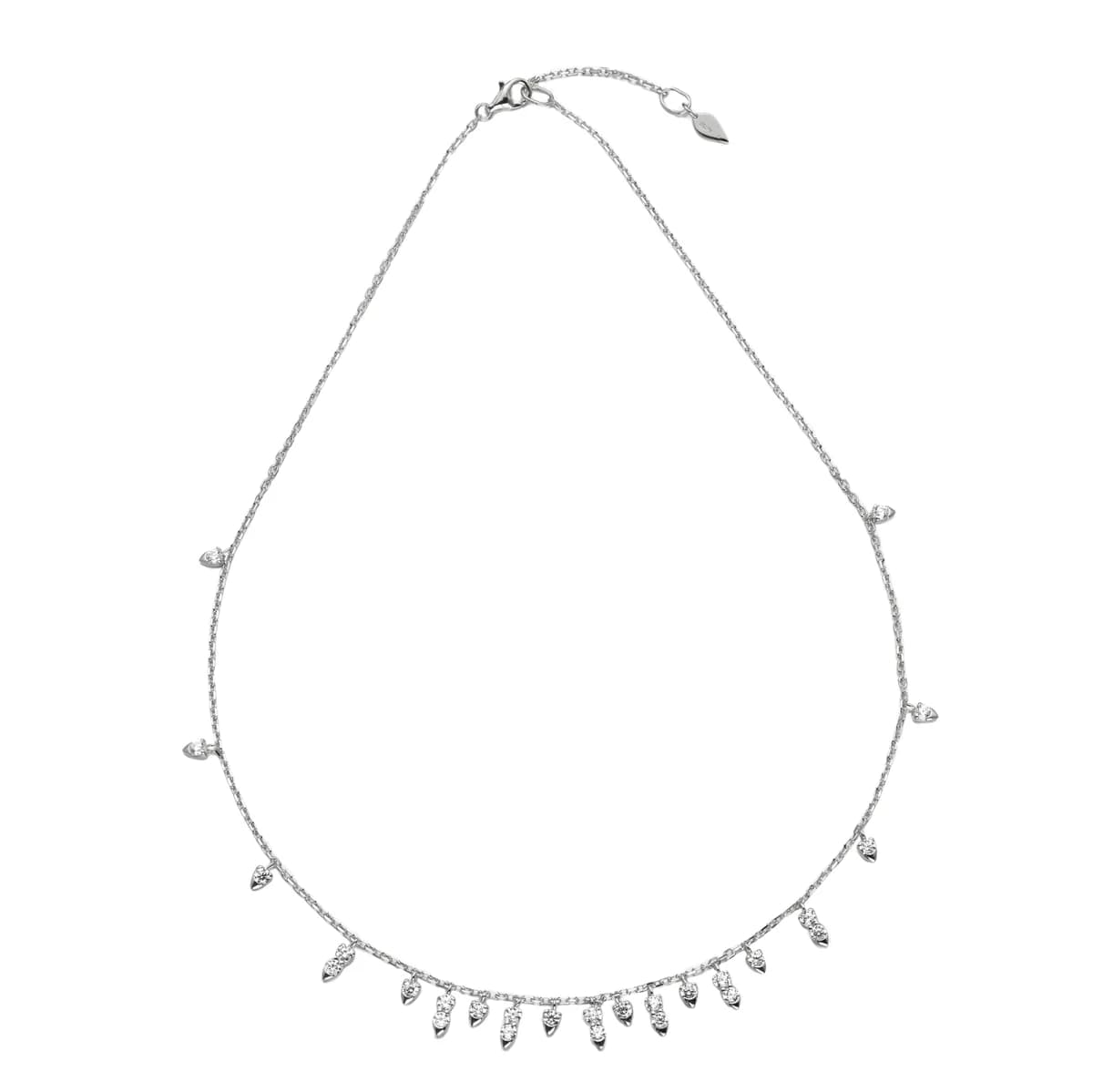
These real catalog products are visual and construction references for specification discussions. Their published product data is unchanged; they are not presented as the exact product used in this guide.
FAQ
Frequently asked questions
Does necklace length include the clasp?
State the convention for the actual order. An open end-to-end dimension may include the clasp, but part of a closure can overlap when fastened. Identify endpoints, included fittings and the selected closed position rather than assuming every supplier uses the same rule.
Is pendant drop part of chain length?
A hanging pendant normally extends below its support, while an ornament connected between two chain sides can form part of the necklace path. Define the chain path, pendant reference points, bail inclusion and resting orientation separately for the proposed construction.
How should an extender be specified?
Identify every position intended for use and record its usable closed length. Confirm that the actual clasp can engage it. Describe the unused tail separately; its loose length does not increase the closed length at the selected fastening point.
Can one length guarantee the same pendant position for every customer?
No. Neck and body proportions, pendant geometry, attachment, posture and clothing can change placement. Review identified references representative of the intended market and record the observations without presenting them as a universal wearing guarantee.
What needs review when a necklace length changes?
Review the affected SKU dimensions, link and hardware arrangement, pendant center and drop, layer relationships, boundary samples, packaging and schedule. Keep the old record, assess affected quantities and release an acknowledged new version with any required resampling.
Expert review
Zalson Jewelry Product Development & Quality Team
Technical editorial team
Buyer-side specification, reference control and sample-record editorial review. This guide does not report an actual product measurement, fit trial, factory inspection, material analysis, wear test or approved production sample.
Zalson Jewelry is operated by Guangzhou Zalson Jewelry Co., Ltd., established in Guangzhou in 2017. Content is reviewed by the team rather than attributed to an individual spokesperson.
Sources and further reading
- 1GS1: Package and Product Measurement Standard — release 3.3, August 2026; jewellery natural states ↗
- 2QxH: Jewelry Product Measurement & Sizing — retailer-specific conventions ↗
- 3Kate & Kole: Necklace Sizing Guide — placement varies by wearer ↗
- 5Stuller: What to Know About Choosing a Jewelry Chain ↗
- 6Carat Theory: Necklace Length Guide — chain length and pendant drop ↗
Prepare a measurable necklace brief